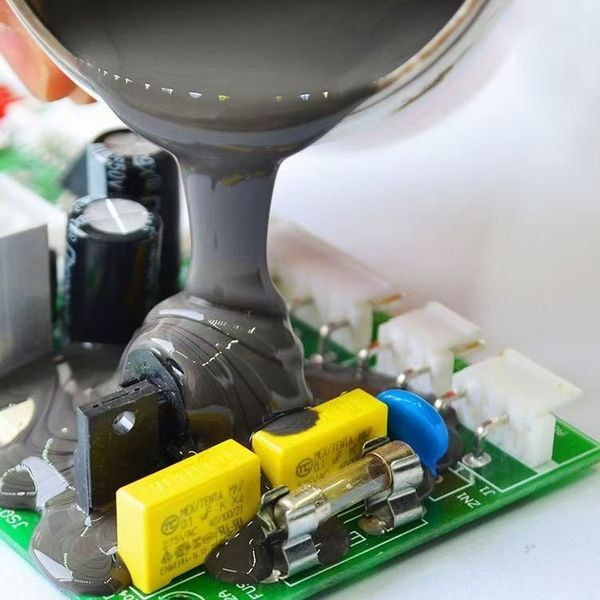



In practical applications, silicone potting compounds occasionally experience clumping, directly affecting the application effect and product protective performance. Many users easily confuse clumping with powder sedimentation, making it difficult to accurately determine the root cause. Below, we will break down the causes of clumping in silicone potting compounds in detail, while clarifying the core differences between clumping and sedimentation, helping you efficiently avoid and solve related problems.
I. Main Causes of Clumping in Potting Compounds
1. Insufficient Production Process Control
Powder settling is a normal phenomenon in the storage of potting compounds. The degree of settling depends on the production dispersion process. If the powder is not evenly dispersed during production or the stirring time is insufficient, the filler cannot be evenly suspended in the colloid, which will accelerate the powder settling and cause a large amount of powder clumps to accumulate at the bottom of the container. If these clumps are not thoroughly dispersed before subsequent use, they will compact and harden over a long period, forming hard clumps. This is the main potential cause of product clumping.
2. Improper On-Site Operation
Qualified potting compounds will naturally settle under gravity during long-term storage. If users do not stir the compound sufficiently before application, especially if the powder settling at the bottom of the container is not mixed evenly, it will cause uneven composition of the colloid. The powder at the bottom will continue to accumulate and compact, gradually hardening and clumping. The longer the storage time, the more serious the clumping problem becomes, directly damaging the uniformity and performance of the colloid. Therefore, it is recommended to prepare only what is needed and avoid long-term stockpiling.
3. Raw Material Filler Quality Issues
The quality of filler powder determines the stability of the colloid. Some manufacturers fail to adequately prevent moisture in their powder storage. Even after thorough mixing, damp powder easily clumps together and cannot be dispersed by ordinary stirring. Furthermore, without a comprehensive particle size testing system, significant differences in particle size between batches of powder can drastically reduce suspension stability, causing severe uneven sedimentation and forming stubborn clumps that are difficult to disperse again, resulting in batch-to-batch performance deviations.
II. The Core Difference Between Clumping and Sedimentation
Sedimentation and clumping are two completely different states with significantly different handling methods and hazards.
First, their states and properties differ. Sedimentation is a normal physical phenomenon, characterized by a thinner top and thicker bottom, with loose powder at the bottom, without hardening or solidification, and the colloid itself shows no quality change. Clumping is an abnormal defect resulting from the deterioration of sedimentation; it is a hard, solid clump formed by powder compaction and moisture agglomeration, and is a product quality issue.
Second, their reversibility differs. Slight sedimentation can be completely repaired; thorough mixing before use will reconcile the colloid and will not affect performance. Clumps that cannot be broken up by conventional stirring will lead to uneven curing, adhesion failure, and reduced protective performance after application, and in severe cases, the entire container of adhesive may be rendered unusable.
III. Summary and Prevention Recommendations
Clumping of potting compound is a problem caused by a combination of factors, including raw materials, production processes, and on-site operations. Severe settling is a prerequisite for clump formation. Preventing clumping requires a two-pronged approach: Manufacturers should choose reputable suppliers with comprehensive raw material testing and standardized production control to ensure uniform powder dispersion and stable material quality; users should follow proper usage habits, avoid prolonged storage of the adhesive, and thoroughly stir the entire container of adhesive before application to break up any settled powder at the bottom, effectively preventing clumping and ensuring stable product performance.