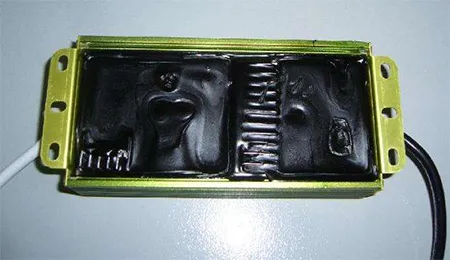


Epoxy, silicone, and polyurethane potting compounds are the three major potting materials in industry, with epoxy potting compounds having the widest application coverage and a prominent position in electronics, new energy, automotive, and military industries. However, epoxy potting compounds have significant performance shortcomings, with both single-component and two-component products having their limitations. This article briefly outlines their core disadvantages and explains why they are still widely used.
I. Core Disadvantages of Epoxy Potting Compounds
Epoxy potting compounds are mainly divided into two categories: two-component and single-component. Their performance shortcomings differ significantly, and their applicable scenarios are somewhat limited.
(I) Disadvantages of Two-Component Epoxy Potting Compounds
Two-component products are the most widely used in the market, but they have shortcomings in application compatibility and environmental resistance. First, the high viscosity and poor permeability of the adhesive make it difficult to fill tiny gaps in components. Furthermore, they cannot be adapted to fully automated high-speed potting equipment, relying mostly on manual or semi-automatic application, resulting in low production efficiency and high construction costs, which is not conducive to large-scale production. Secondly, the cured adhesive layer is too hard and lacks toughness, exhibiting weak resistance to temperature fluctuations. Under alternating high and low temperature conditions, it is prone to cracking due to stress and lacks self-healing properties. Once cracked, it directly loses its waterproof, moisture-proof, and insulating protective capabilities, shortening the equipment's lifespan. Finally, the product has poor low-temperature performance and shock resistance. In ultra-low temperature environments, the adhesive layer is prone to embrittlement and shrinkage, damaging precision substrates and making it unsuitable for harsh conditions involving low temperatures and high-frequency vibrations.
(II) Disadvantages of Single-Component Epoxy Potting Compounds
The core limitations of single-component products lie in the curing and storage stages. This type of adhesive cannot cure at room temperature and requires high-temperature heating to complete the curing reaction. This places higher demands on production equipment and processes, resulting in more complex procedures and higher energy consumption, making it unsuitable for potting workpieces that are not heat-resistant. Furthermore, its storage conditions are stringent, requiring storage in a cool environment below 25°C. Long-term storage necessitates refrigeration; substandard temperature and humidity can easily lead to premature deterioration, clumping, and failure of the adhesive. This places extremely high demands on warehousing and logistics, resulting in poor shelf-life stability.
II. Core Reasons for the Widespread Application of Epoxy Potting Compounds
All three major potting compounds have inherent defects: silicone has low bonding strength, and polyurethane has weak temperature and aging resistance. In contrast, the shortcomings of epoxy potting compounds can be circumvented through scenario adaptation, and their core advantages are more aligned with mainstream industrial needs, resulting in a higher overall cost-effectiveness.
The core principle of industrial material selection is to leverage strengths and avoid weaknesses. Epoxy potting compounds, with their stable performance, excellent protective capabilities, and high cost-effectiveness, are suitable for the vast majority of industrial scenarios. A few shortcomings can be mitigated through process, formulation, and scenario optimization, thus maintaining their status as the mainstream material in the industrial potting field.