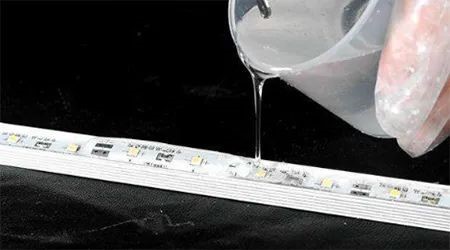



Silicone potting compound boasts excellent overall performance, providing outstanding electrical insulation, waterproofing, moisture resistance, and strong sealing after curing. It exhibits no significant shrinkage during curing, and the compound is soft and removable, facilitating disassembly and repair in case of electronic device malfunctions. It is a commonly used material for the encapsulation and protection of electronic devices. Many people are curious: What is the state of silicone potting compound after complete curing? Is it transparent?
I. Overall State of Silicone Potting Compound After Curing
The curing of potting compound consists of two stages: surface drying and complete curing. Surface drying refers to the curing of the surface layer; the interior is not yet completely dry. After complete curing, the surface of the compound is smooth and glossy, with a dry and non-sticky feel, and an overall soft and flexible texture. The cured compound can tightly adhere to the gaps between components, forming a complete protective layer, effectively preventing the intrusion of moisture, dust, and humidity, providing comprehensive protection for the stable operation of electronic components.
II. Is it always transparent after curing?
The answer is no. The color of cured silicone potting compound remains consistent with its original color during application; it is not always transparent. Mainstream colors on the market include transparent, black, gray, and white. Transparent potting compounds may slightly yellow over time, which is a normal aging phenomenon and will not affect core performance characteristics such as sealing and insulation. Darker potting compounds, such as black and gray, offer more flexible color matching and can be customized to suit different application scenarios, broadening their applicability.
III. Key Considerations for Selection
In summary, silicone potting compounds come in a variety of colors after curing, with transparent being just one option. When purchasing, a comprehensive selection based on appearance requirements, heat dissipation needs, and operating conditions is crucial to achieving optimal encapsulation and protection.