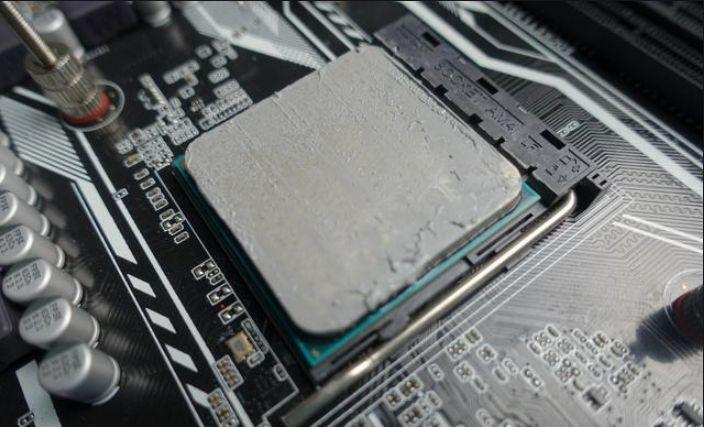



Many people are unaware of the actual function of thermal paste: the contact surface between heat-generating components such as CPUs and chips and the heatsink is not perfectly flat; tiny gaps, barely perceptible to the naked eye, are filled with air, which has extremely poor thermal conductivity. Applying thermal paste between them perfectly fills these gaps, expelling air and creating an efficient heat conduction channel, allowing heat to be quickly conducted from the heat-generating component to the heatsink, fully utilizing the heat dissipation capacity of the heatsink.
Is the thermal conductivity of thermal paste important?
The heat dissipation assistance function of thermal paste is crucial and cannot be ignored. Without the filling and thermal conduction of thermal paste, an insulating air layer exists between the heatsink and the hardware, significantly reducing heat dissipation efficiency. This can easily lead to high-temperature malfunctions, throttling, and, with prolonged high-temperature operation, accelerate the aging of electronic components and shorten the lifespan of the equipment. High-quality thermal paste possesses stable thermal conductivity, high-temperature resistance, and resistance to drying and volatilization, making it suitable for various scenarios such as electronics, new energy, automotive, and industrial control equipment. It effectively stabilizes the operating temperature of equipment, ensuring long-term stable hardware operation.
Correct Application Method for Thermal Paste
Many beginners are accustomed to applying thermal paste in circular motions. This method easily leads to uneven thickness and residual air bubbles, severely affecting heat conduction. The correct method is simple and easy to follow:
Precautions for using thermal paste: