


As midsummer arrives, many electronics manufacturers are finding that drastic changes in workshop temperature and humidity are narrowing the operating window for potting adhesives. The slow curing issues that frequently occurred in winter are being replaced by new problems in summer, such as "excessively fast gelling," "surface skinning," and "dense bubble formation." Tensan's technical team notes that silicone potting adhesives are highly sensitive to temperature and humidity, and different seasons require matching process parameters. Neglecting seasonal adjustments is the root cause of seasonal fluctuations in potting defect rates.
High Temperature and High Humidity: The "Hidden Killer" of Potting Operations
In high-temperature summer environments, the working time (pot life) of two-component silicone potting adhesives is shortened by 40%-60% compared to winter. Tensan's measured data shows that when the ambient temperature rises from 20°C to 35°C, the pot life of the same adhesive can plummet from 45 minutes to just 15 minutes. If production lines still operate at winter rhythm, they are highly prone to issues such as premature thickening of the adhesive, insufficient leveling, and trapped bubbles during the potting process.
Meanwhile, in high-humidity environments (relative humidity >80%), moisture may participate in or interfere with the crosslinking reaction of condensation-cure potting adhesives, resulting in a whitened surface after curing and internal micro-bubbles. In severe cases, it can even trigger side reactions of "moisture curing," altering material properties.
Tensan's Seasonal Process Adjustment Solutions
To address seasonal fluctuations in potting adhesives, Tensan has developed a standardized response strategy to help clients achieve "smooth winter-to-summer transitions":
|
Season |
Main Issues |
Tensan Response Strategy |
|
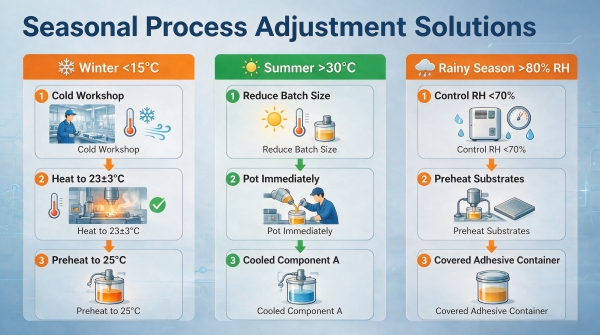
Winter (<15°C) |
Extremely slow curing, tacky surface |
Heat work area to 23±3°C; preheat adhesive to 25°C before mixing; apply post-curing for thin-layer potting |
|
Summer (>30°C) |
Excessive gelling, bubbles, poor leveling |
Reduce batch size per mix; accelerate potting pace; use immediately after mixing; moderately lower Component A temperature to extend pot life |
|
Rainy season with high humidity (>80% RH) |
Surface skinning, internal micro-bubbles |
Dehumidify potting area (control RH <70%); preheat substrates before potting; avoid leaving adhesives exposed outdoors during humid seasons |
Tensan points out that seasonal process adjustments involve not only operating parameters but also adhesive material selection. For clients whose production lines cannot achieve constant temperature and humidity control, Tensan can recommend wide-window adhesives (pot life >60 minutes) or low-temperature fast-curing formulations to reduce seasonal impact from the material side. Additionally, Tensan emphasizes that operators should practice the "Three Observations": monitor ambient temperature and humidity, observe the adhesive state after mixing, and inspect cured sample performance — forming a routine inspection habit.
Industry Perspective: Seasonal Quality Control is a "Basic Skill," Not a "Bonus"
As global shipments of new energy vehicles and energy storage products surge, end customers' requirements for batch-to-batch consistency have extended from laboratory conditions to actual production scenarios across different seasons and locations. Tensan believes that the ability to manage seasonal process variations is becoming an invisible threshold separating "qualified suppliers" from "preferred suppliers" for electronics manufacturers. Tensan has now opened a free consultation window for seasonal process parameters to help production lines smoothly navigate periods of drastic temperature and humidity fluctuations.