

Industry dynamic

"Hidden Failures" in Potting Adhesives Alert the Industry — Tensan Advocates for Full-Process Quality Control System

2026-07-22 - Leave me a message

As new energy vehicle electronic control systems, photovoltaic inverters, and energy storage BMS place increasingly stringent demands on long-term reliability, the protective effectiveness of silicone potting adhesives has risen from a "functional safeguard" to a "safety baseline." However, failure analysis reports recently disclosed by multiple third-party testing institutions reveal that approximately 15%-20% of early failures in batch-delivered potting modules are not caused by the adhesive material itself, but rather by process fluctuations and quality control blind spots on the production line.

Three Major Blind Spots of "Hidden Failure" to Be Resolved

Based on a synthesis of multiple failure analysis cases, the three most easily overlooked blind spots in current potting processes include:


  • Blind Spot 1: Insufficient temperature recovery. Adhesive materials taken from cold storage in winter are mixed without being fully returned to room temperature. The low-temperature adhesive has increased viscosity, leading to uneven mixing. Meanwhile, when cold adhesive contacts hot substrates, condensation water films easily form on the surface, directly undermining interfacial wetting performance.
  •  Blind Spot 2: Uneven temperature field in curing ovens. Temperature variations across different zones within most production line curing ovens can reach ±5°C or more, resulting in inconsistent curing degrees within the same batch — some modules become "over-cured" and brittle, while others are "under-cured" and tacky.
  •  Blind Spot 3: Drifting mixing ratios. Automatic proportioning equipment that has not been calibrated for extended periods gradually deviates from the correct A:B ratio due to pump wear. However, daily line inspections often lack mixing ratio verification steps, meaning problems are typically only discovered days after mass production has already begun.


Tensan: From "Selling Adhesives" to "Managing Processes"

In response to these industry-wide pain points, Tensan is driving a transformation in its own role — evolving from a mere adhesive supplier to a "process third-party consultant" for client production lines. The full-process quality control system proposed by Tensan covers five key control points:


  •  Incoming material control: Strict enforcement of FIFO (First-In, First-Out); expired adhesives are physically isolated and mandatorily scrapped;
  • Temperature recovery specification: After removal from storage, adhesives must be allowed to rest and return to room temperature at 23±3°C for at least 4 hours (longer for large packages); infrared thermometry must confirm that the core temperature has reached the target before being used on the line;
  • Proportioning calibration: Automatic metering equipment must undergo weight verification before each shift, ensuring A:B ratio deviation ≤±1%;
  •  Curing monitoring: Multiple thermocouples are arranged inside the curing oven, with regular temperature field mapping to ensure effective curing zones cover all loading positions;
  •  Batch traceability: Cured samples are retained from each potting batch as in-process validation evidence for curing degree, hardness, and bonding strength.


Industry Trend: Quality Control Moving Forward Gains Consensus

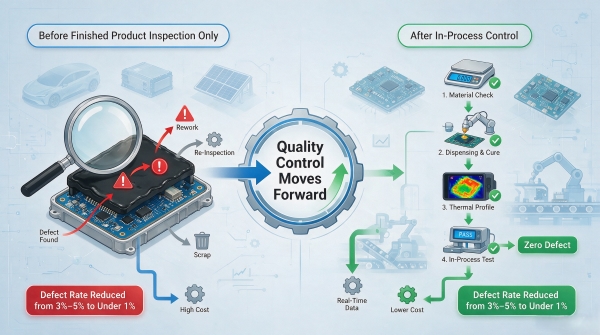
Industry experts point out that as subsidies in the new energy sector decline and end customers continue to extend warranty period requirements, electronics manufacturers are shifting from "prioritizing material selection while neglecting process management" to a balanced emphasis on both materials and processes. Tensan believes that moving quality control checkpoints from finished product inspection to in-process control is the most cost-effective approach to reducing potting failure risks. Tensan has already provided production line process diagnostics and standardization services to multiple leading new energy enterprises, helping clients reduce the average potting defect rate from the industry norm of 3%-5% to less than 1%.

Send Inquiry


X
We use cookies to offer you a better browsing experience, analyze site traffic and personalize content. By using this site, you agree to our use of cookies. Privacy Policy
Reject Accept