Organic silicone potting glue is widely adopted for waterproof, insulation and shock protection of new energy power supplies, automotive electronic control modules and LED drive boards. In actual construction, many manufacturers encounter foaming, honeycomb voids inside cured glue layers, which seriously reduce insulation and waterproof performance. This article, based on industry experience from Tensan, systematically analyzes the root causes of potting foaming and provides standardized operational solutions.
I. Main Causes of Silicone Potting Foaming
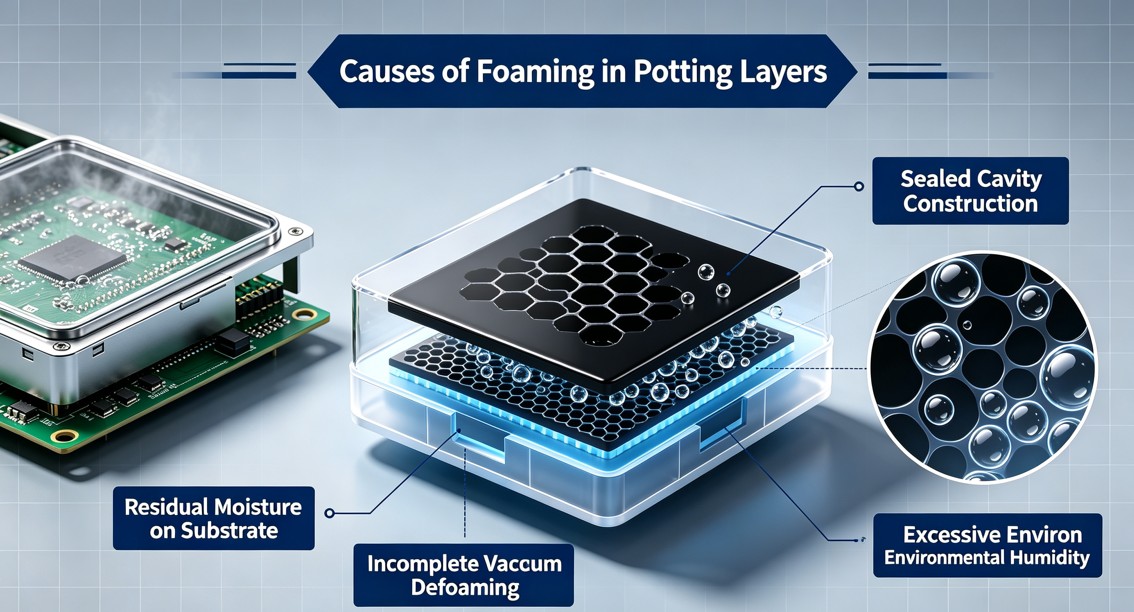
• Residual Moisture on Substrate Surface
If PCB, plastic or metal shell retains water vapor, dew or cleaning liquid residue, water will vaporize under curing temperature and form dense bubbles inside the silicone.
•Incomplete Vacuum Defoaming
After mixing two-component silicone glue, insufficient vacuum pumping time cannot eliminate air wrapped during stirring, resulting in tiny air holes after curing.
• Sealed Closed Cavity Construction
Totally enclosed modules without reserved exhaust holes trap volatile gas produced during silicone crosslinking reaction, leading to expansion and large hollow cavities.
• High Humidity Construction Environment
When workshop humidity exceeds 75%, water molecules in the air will continuously blend into the glue liquid during pouring, triggering foaming.
II. Standardized Operation to Eliminate Foaming Problems (Tensan Recommended Process)
-
Pre-treatment: Fully bake electronic shells and circuit boards at 60℃ for 30 minutes to remove all internal moisture, wipe surface oil stains with anhydrous ethanol.
-
Defoaming Process: Put mixed silicone glue into vacuum defoamer for 5–10 minutes until no continuous air bubbles rise out of the liquid surface.
-
Pouring Operation: Pour glue slowly along the inner wall of the workpiece to avoid rolling and wrapping air; reserve small exhaust holes for fully closed casings.
-
Environmental Control: Arrange potting work in constant temperature & humidity workshop, keep indoor humidity below 60%.
III. Product Usage Limitations
Fast-curing silicone potting glue is not suitable for fully sealed, air-tight small modules. For fully enclosed products, Tensan can customize low-volatility slow-curing silicone formula according to customer demands. Expired silicone glue is forbidden for production use, as reduced crosslinking activity will cause continuous foaming.
Summary: Controlling substrate dryness, vacuum defoaming and workshop humidity are the core methods to solve silicone foaming defects. Following Tensan standardized construction processes effectively improve the yield rate of electronic potting.