


Heat dissipation is crucial for ensuring the lifespan and luminous effect of LED lighting fixtures. Thermally conductive silicone sheets and thermally conductive grease are commonly used heat-conducting materials, each with its own advantages and disadvantages. The choice must be made based on the application scenario and performance requirements; there is no absolutely "better" solution, only the most suitable one.
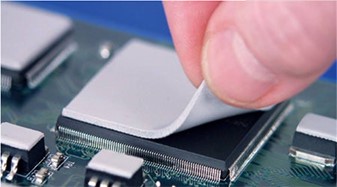
From a practical perspective, thermally conductive silicone sheets have clear advantages. They are flexible sheets with thicknesses ranging from 0.5-10mm, can be cut, die-cut, and perforated at will, have a slight adhesiveness, and can be easily applied after peeling off the film, making the process clean and convenient, significantly saving labor costs. They also have excellent shock resistance, making them suitable for LED matrices and through-hole LEDs with pins. Thermally conductive grease, on the other hand, is a paste that requires manual, even application. Large-area application is difficult, and it can easily contaminate components and cause short circuits. Labor costs are also higher, making it more suitable for simple heat dissipation of individual LED chips.
In terms of core performance and lifespan, thermally conductive silicone sheets are superior across the board. It boasts exceptional insulation, with an insulation index exceeding 4000 volts at a thickness of 1mm. Its solid form prevents the silicone oil from volatile, exhibiting excellent aging resistance and a lifespan exceeding ten years, while maintaining stable long-term thermal conductivity. Thermal grease, due to the addition of metal powder, exhibits poor insulation, easily releasing free substances at high temperatures, contaminating lenses, reducing light transmittance, and aging rapidly, typically with a lifespan of less than one year. While it offers lower short-term thermal resistance and slightly better thermal conductivity at the same coefficient, its long-term performance degrades significantly.
In terms of parameters and cost-effectiveness, thermally conductive silicone pads cover a wider range of thermal conductivity (1.0~7.9W/mK), suitable for high-power LED heat dissipation; thermal grease, with a coefficient of 1.0~5.0W/mK, is only suitable for low-power applications. Thinner applications of silicone grease result in better thermal conductivity and lower initial purchase costs, seemingly offering higher short-term cost-effectiveness. Silicone pads have slightly higher initial costs, but considering lifespan and maintenance costs, their long-term cost-effectiveness is superior, and they can be repeatedly disassembled and reassembled, offering far greater reworkability than firmly bonded silicone grease.
In short, thermal grease can be used temporarily for low-power single LEDs, but thermal silicone pads are a better choice for high-power, matrix-type LEDs that require long-term and stable heat dissipation.