


As the new energy vehicle, photovoltaic energy storage, and LED lighting industries continue to escalate their requirements for electronic component protection, the application depth and breadth of organic silicone potting glue have been steadily expanding. However, in actual production, process challenges such as incomplete curing and interfacial delamination between the adhesive layer and the substrate remain major bottlenecks affecting long-term product reliability. To address these industry pain points, TENSAN, drawing on years of technical expertise and on-site service experience, has launched a full-process standardized potting process solution, helping manufacturers transition from "experience-driven" to "standard-driven" process management.
Incomplete Curing and Delamination: Two Core Process Challenges
TENSAN's technical team has observed in practical service that incomplete curing is particularly prevalent in low-temperature winter environments and thin-layer potting scenarios. When the ambient temperature falls below 15°C, the crosslinking reaction rate decreases significantly; when the adhesive layer thickness is less than 1mm, the reaction exotherm cannot be effectively retained, resulting in exponentially prolonged curing time. In addition, excessive deviation in the A:B mixing ratio or inadequate mixing can also lead to localized curing defects.
Interfacial delamination is another frequently occurring issue. Flux residues or fingerprint oils remaining on the PCB surface, or excessively low surface energy of plastic housings (especially PP and PE materials), can prevent the adhesive from forming effective chemical bonds with the substrate. Meanwhile, the volumetric shrinkage stress associated with fast-curing systems, as well as severe thermal shock experienced by modules after potting, are also significant contributors to interfacial cracking.
TENSAN Standardized Process Solutions: Precise, Controllable, and Reproducible
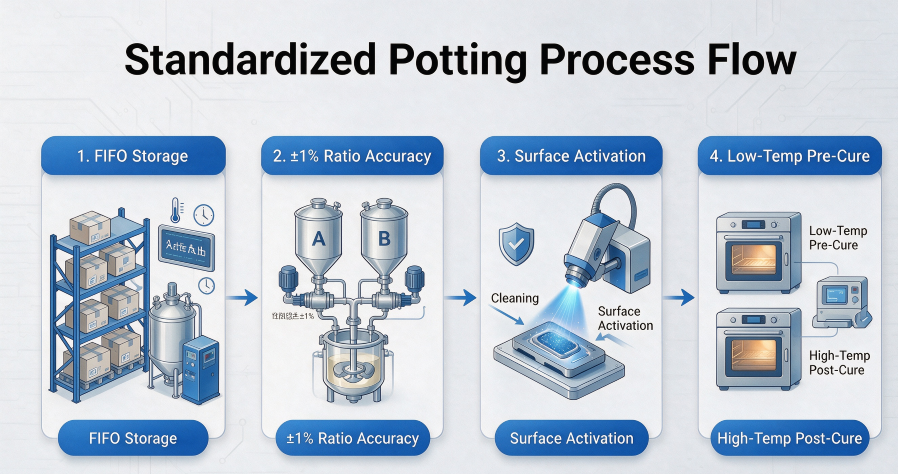
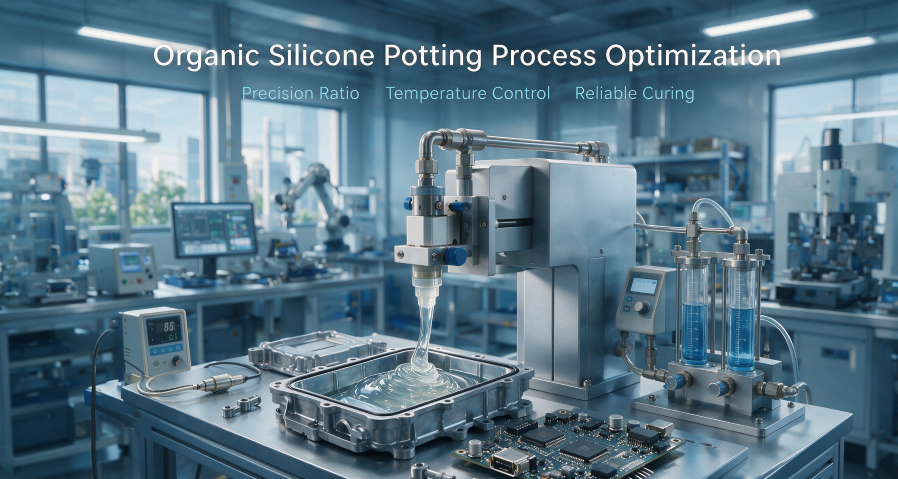
To address the above issues, TENSAN has proposed a systematic set of process improvement measures. In the proportioning and mixing stage, TENSAN recommends using automatic metering equipment to control the A:B ratio error within ±1%, and selecting mixing tubes of appropriate specifications to ensure thorough homogenization of the adhesive. In terms of temperature control, the potting work environment should be maintained at 23±3°C, and during winter construction, the adhesive should be preheated to 25°C before mixing.
For thin-layer potting scenarios, TENSAN recommends adopting heat-assisted curing—post-curing in an 80-100°C oven for 30-60 minutes—to compensate for insufficient reaction heat. In the surface pretreatment stage, PCBs should undergo plasma cleaning or corona treatment, while plastic housings with low surface energy such as PP and PE should be surface-activated to increase surface energy to above 38 dynes/cm. Furthermore, the stepwise curing process advocated by TENSAN—"low-temperature pre-curing + high-temperature post-curing"—effectively reduces volumetric shrinkage and minimizes interfacial stress concentration.
Material Customization and Full-Process Management Equally Emphasized
For high-reliability application scenarios, TENSAN offers adhesion-enhanced formulations that incorporate special coupling agents to strengthen chemical bonding between the adhesive layer and various substrates including metals, plastics, and ceramics. For products sensitive to thermal stress, low-shrinkage slow-curing systems provide customers with an option to mitigate delamination risk from the material side.
At the same time, TENSAN emphasizes that adhesive storage management should not be overlooked. The FIFO (First-In, First-Out) principle must be strictly implemented, and expired products are strictly prohibited from use. Adhesives must be fully returned to room temperature before application to prevent condensation caused by temperature differences between cold adhesive and hot substrates, which could otherwise compromise interfacial wetting.
Industry Outlook: Process Refinement Determines Long-Term Reliability
As automotive electronics and energy storage systems impose increasingly stringent requirements on long-term reliability, potting processes have evolved from simple "pour and cure" operations into comprehensive refined management covering material selection, surface pretreatment, precise proportioning, curing profile control, and post-treatment. The standardized process system established by TENSAN is providing electronic manufacturing enterprises with quantifiable and replicable operational frameworks, laying a solid foundation for the high-quality development of the new energy and automotive electronics industry chain.