


TS107E is a widely used no‑clean, leaded solder paste that is specifically formulated to minimise head‑in‑pillow defects in BGA and CSP soldering. As a Low Head‑in‑Pillow Defect Solder Paste, it delivers outstanding Head‑in‑pillow defect resistance, making it the ideal choice for assemblies where PCB warpage, component coplanarity variations, and thermal mismatch are critical concerns. Beyond its exceptional defect prevention, TS107E also provides excellent ultra‑fine pitch printing capability, high in‑circuit probe test yield, and long‑term reliability, ensuring robust performance in demanding electronic manufacturing environments.
TS107E is a widely used no‑clean, leaded solder paste that is specifically formulated to minimise head‑in‑pillow defects in BGA and CSP soldering. As a Low Head‑in‑Pillow Defect Solder Paste, it delivers outstanding Head‑in‑pillow defect resistance, making it the ideal choice for assemblies where PCB warpage, component coplanarity variations, and thermal mismatch are critical concerns. Beyond its exceptional defect prevention, TS107E also provides excellent ultra‑fine pitch printing capability, high in‑circuit probe test yield, and long‑term reliability, ensuring robust performance in demanding electronic manufacturing environments.
Solder Paste Composition
TS107E Low Head‑in‑Pillow Defect Solder Paste consists of Sn63/Pb37 alloy powder and solder flux. According to the technical datasheet, this product uses the Sn63/Pb37 eutectic alloy (63% tin, 37% lead) with a melting point of 183°C. The flux content is approximately 5% (by weight), utilising an ROL0‑grade activator system (the highest reliability level per IPC J‑STD‑004). This formulation ensures minimal residue after reflow, full and reliable solder joints, and fully meets no‑clean process requirements – while the unique activator chemistry contributes directly to its superior Head‑in‑pillow defect resistance.
Solder Paste Type – Customisable Powder Size Options
TS107E Low Head‑in‑Pillow Defect Solder Paste is available in a wide range of powder sizes to suit different printing and dispensing needs, while maintaining its outstanding Head‑in‑pillow defect resistance across all variants. The product family offers the industry’s broadest selection of Solder Paste Type options, including:
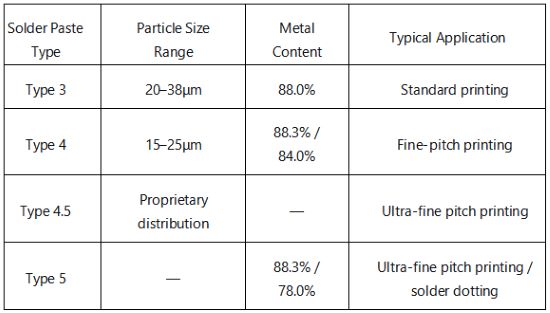
Regardless of the powder type chosen, TS107E consistently delivers industry‑leading Head‑in‑pillow defect resistance, ensuring high first‑pass yields even in the most challenging BGA and CSP applications.
Sn63/Pb37 Alloy Advantages
As a typical Low Head‑in‑Pillow Defect Solder Paste, TS107E utilises the Sn63/Pb37 eutectic alloy, offering the following core benefits:
This alloy system, combined with the optimised flux, ensures that TS107E achieves complete coalescence and robust joint integrity, directly contributing to its exceptional Head‑in‑pillow defect resistance.
Flux and Electrical Reliability
The flux in TS107E employs an ROL0‑grade activator system (IPC J‑STD‑004 highest reliability level) and is halogen‑containing (confirmed by titration and silver halide tests). This flux system ensures that the Low Head‑in‑Pillow Defect Solder Paste passes all of the following tests, while also providing the rheological properties essential for Head‑in‑pillow defect resistance:
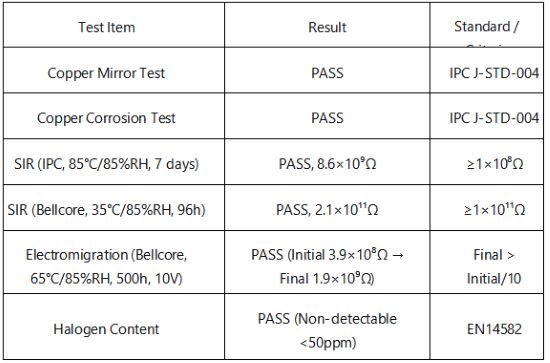
This flux system leaves colourless, transparent, dry, and reliably insulating residue after reflow, meeting no‑clean requirements while delivering IPC Class III voiding performance (the highest IPC 7095 classification). The stable residue also helps maintain consistent contact resistance for ICT probing, complementing its Head‑in‑pillow defect resistance benefits.
Printing Performance and Process Parameters
TS107E Low Head‑in‑Pillow Defect Solder Paste demonstrates outstanding printing consistency and high process capability index (Cpk) on the printer, even at ultra‑fine pitch. The key printing parameters for this product are:
This product exhibits minimal viscosity variation during continuous printing at 25°C/50%RH, significantly reducing cleaning frequency and improving production line efficiency. Its stable print performance is a key enabler for achieving high Head‑in‑pillow defect resistance, as consistent deposit volume and shape are critical for reliable BGA joint formation.
Handling and Process Guidelines
TS107E Low Head‑in‑Pillow Defect Solder Paste must be stored refrigerated at 0–10°C (shelf life: 6 months). Prior to use, the paste should be allowed to warm to room temperature for approximately 4 hours (ensure temperature ≥19°C before opening), and then mixed:
After printing, reflow should be completed as soon as possible. The reflow profile recommends a peak temperature of 210–220°C (above the 183°C melting point), and can be performed in air or nitrogen atmospheres. Following these guidelines helps preserve the product’s Head‑in‑pillow defect resistance by ensuring optimal flux activity and coalescence.
Core Differentiating Advantages – Exceptional Head‑in‑Pillow Defect Resistance and More
TS107E Low Head‑in‑Pillow Defect Solder Paste offers three industry‑leading advantages:
Application Scenarios and Supply Capacity
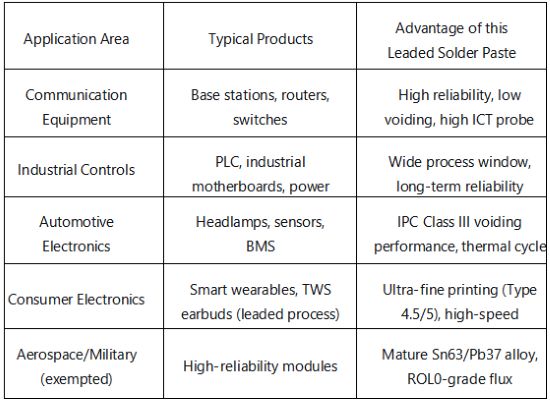
TS107E Low Head‑in‑Pillow Defect Solder Paste has been deployed in volume production across the following sectors, where its Head‑in‑pillow defect resistance delivers tangible quality and yield improvements: