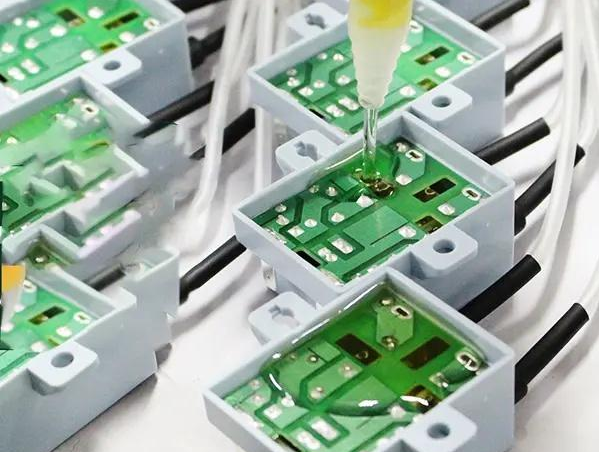



Thermally conductive potting compounds and thermally conductive greases are widely used thermally conductive materials in electronic products. They not only achieve efficient heat dissipation but also possess excellent waterproof, moisture-proof, and insulating properties. Under their protection, the operational stability and performance of electronic products can be effectively improved, and their lifespan extended.
Before curing, thermally conductive potting compounds are liquid with good fluidity. Their viscosity varies depending on product performance, materials, and manufacturing processes. Only after complete curing can the potting compound realize its full value, achieving multiple functions such as waterproofing, moisture resistance, thermal conductivity, privacy protection, corrosion resistance, dustproofing, insulation, temperature resistance, and shock resistance. So, what core performance requirements must be met when selecting a thermally conductive potting compound suitable for electronic components?
1. Non-corrosive: The colloid has no corrosive effect on electronic components and circuits, preventing damage to core components;
2. Excellent deformability: Even after necessary mechanical processing, the cured colloid will not deform, ensuring the positional stability of components;
3. Resistant to thermal shock: It can withstand drastic temperature changes between -60℃ and 200℃, maintaining its elasticity without cracking or splitting;
4. Flexible curing: It can be cured at room temperature or with heating, adapting to different production processes;
5. High thermal conductivity: It possesses excellent thermal conductivity. Currently, products with high thermal conductivity requirements demand potting compounds with a thermal conductivity of 2.0-3.0 W/m.k, effectively improving the heat dissipation efficiency of electronic products and preventing overheating damage;
6. Weather and salt spray resistance: It has excellent weather resistance and salt spray resistance, effectively resisting the erosion of natural environments (such as humidity, salt spray, ultraviolet radiation, etc.), ensuring the long-term stable operation of electronic components;
7. Strong insulation: Excellent electrical insulation performance; after potting, it effectively improves the insulation level between internal components and circuits, eliminating the risk of short circuits.
8. Hydrophobic and moisture-proof: Possesses excellent hydrophobic properties; after potting, it significantly improves the moisture resistance of electronic components, adapting to humid working environments.
For electronic product potting, silicone potting compounds are preferred. Their advantage lies in the ability to add functional fillers to impart customized properties such as electrical conductivity, thermal conductivity, and magnetic permeability. It is worth noting that silicone potting compounds have relatively low mechanical strength, a characteristic that facilitates product repair—if a component malfunctions, the potting compound can be easily broken open to replace it with a new one, eliminating the need for complete scrapping and significantly reducing repair costs.