




As the power density of new energy vehicle electronic control modules and energy storage systems continues to rise, the interfacial bonding reliability of silicone potting glue is facing unprecedented challenges. Industry surveys show that insulation failure and electrochemical corrosion caused by interfacial debonding between the adhesive layer and PCB boards, plastic housings, or power devices now account for more than 30% of potting quality complaints. Bonding failure has become an even more concealed quality hazard than bubbles and incomplete curing.
Adhesion Promotion Technology Becomes a Hot Topic in Industry R&D
Recently, multiple material companies have been making strategic moves around the adhesion performance of potting adhesives. Public information shows that Guangdong Jinge New Materials has filed a patent for an alkoxy-modified adhesion promoter, which can significantly enhance the bonding strength of potting glue on multiple substrates by adding 0.3-1.5 parts by mass. Kebang Polymer has also published a patent related to modified polydimethylsiloxane, aiming to improve filler compatibility and overall potting adhesive performance.
Industry experts point out that low-surface-energy plastic housings (such as PP and PE materials) as well as flux residues and fingerprint oils on PCB surfaces are the two major "culprits" behind interfacial delamination. Relying solely on adhesive formulation optimization cannot completely solve the problem; it must be coupled with rigorous surface pretreatment processes — including plasma cleaning, corona treatment, or primer coating — to ensure the substrate surface energy reaches ≥38 dynes/cm.
Tensan: A Systematic Approach from Material Formulation to Process Specification
Addressing industry pain points, Tensan has explicitly incorporated "adhesion reliability" into its full-process potting process management system. Tensan's technical team emphasizes that bonding strength is not merely a formulation issue but a process issue. The company's adhesion enhancement solution covers three major dimensions:
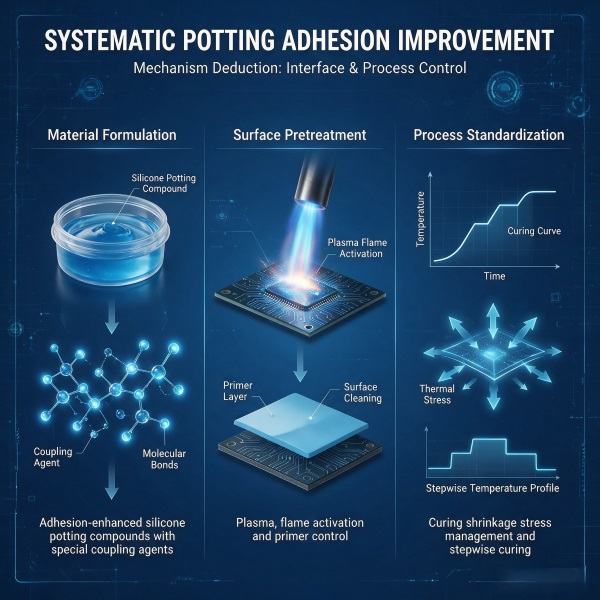
Industry Trend: From "Pouring It In" to "Making It Stick"
As the requirements for 15-20 year service life in automotive electronics and energy storage systems become increasingly stringent, potting protection has evolved from simple "waterproofing and dustproofing" to a stringent test of long-term bonding reliability. Tensan believes that the industry is shifting from "material competition" to "process competition," and companies with full-process process empowerment capabilities will seize the initiative in the next round of market reshuffling.