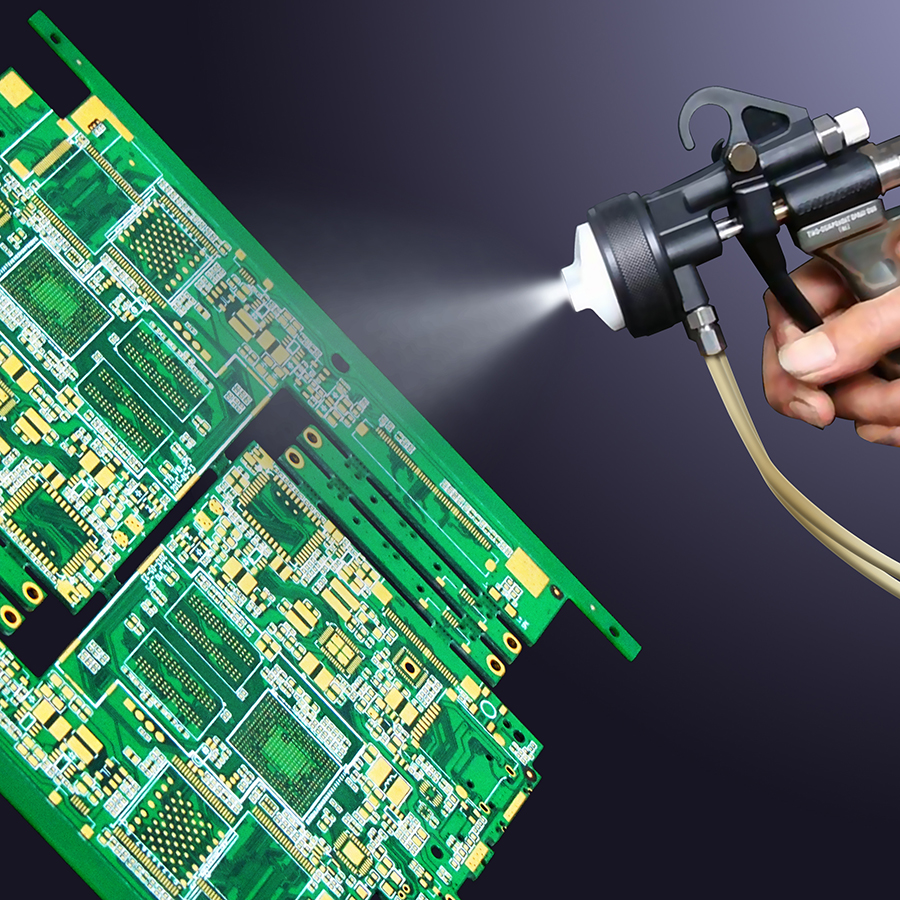



Is a thicker conformal coating always better? Not necessarily. For the same product, a thicker coating increases cost, reduces competitiveness, and hinders miniaturization; conversely, a too-thin coating may compromise protective capabilities and prevent long-term stable operation. A thicker or thinner conformal coating is neither better. Different types of conformal coatings have different thickness requirements; different industries have different requirements; each product has different thickness requirements during use; and the thickness varies depending on the environment and application needs.
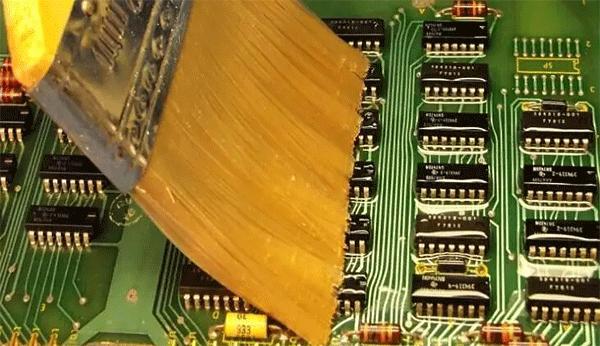
For example, ordinary electronic products don't have particularly high requirements for conformal coating thickness; 20-30 micrometers is generally sufficient. For products with special requirements, multiple coats can be applied, with a second coat applied only after the first coat has fully cured. Industrial and military products have high requirements for conformal coating performance, with a coating thickness of approximately 30-50 micrometers. Choosing a higher-performance conformal coating type provides better protection for the circuit board. The circuit board must use the thinnest coating material to provide maximum protection, minimizing heat retention and additional weight.
So, how do we typically measure the thickness of the conformal coating after application? Below is a brief introduction to three measurement tools and methods:
1. Wet Film Thickness Gauge. Wet film thickness can be measured directly using a suitable instrument. These instruments contain a series of notches, each with a known calibration length. The measuring instrument is placed directly on the wet film for a thin-film measurement. This measurement is then multiplied by the coating's solids percentage to calculate an approximate dry coating thickness.
2. Micrometer. Micrometer thickness measurements are taken at several locations on the circuit board before and after coating. The cured coating thickness is subtracted from the uncoated thickness and divided by 2 to obtain the thickness on one side of the board. The standard deviation of the measurement is then calculated to determine the coating uniformity. Micrometer measurements are best performed with a harder coating that will not deform under pressure.
3. Ultrasonic Thickness Gauge. This measuring instrument uses ultrasonic waves to measure coating thickness. It has advantages over eddy current probes because it does not require a metal backplate. The thickness depends on the amount of time it takes for sound to travel from the transducer, through the coating, and reflect back from the PCB surface. This method is relatively safe and will not damage the PCB.
The normal coating thickness for most circuit board products is 20 to 75 micrometers, with some products having even lower coating thicknesses. Therefore, when selecting conformal coatings, it is necessary to choose the appropriate coating thickness based on the different environments and requirements of each product to better improve its protective capabilities.