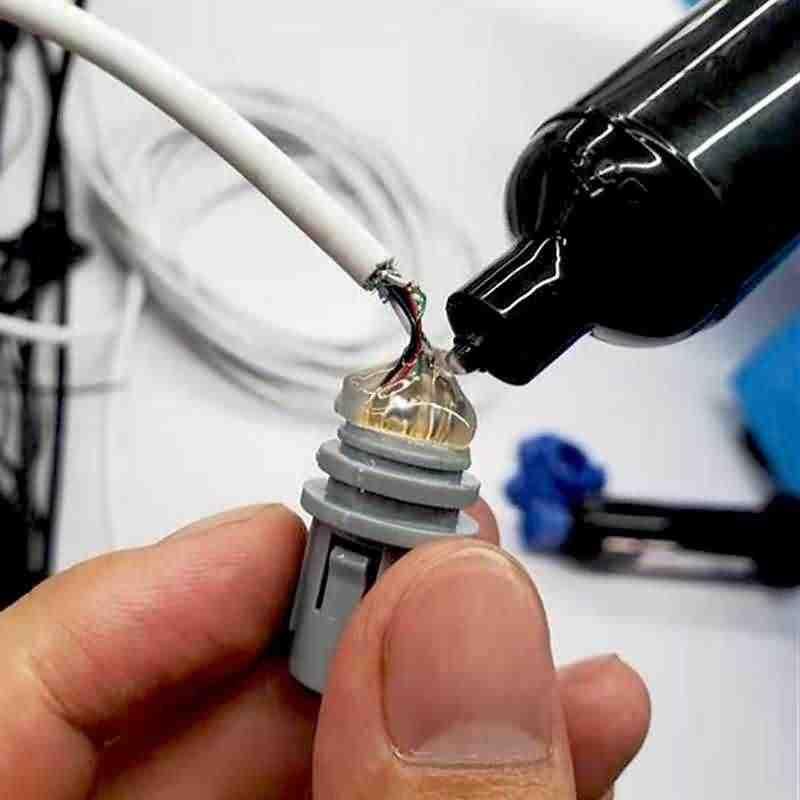



As electronic devices become increasingly sophisticated and their applications more diverse, circuit boards, as core components, directly determine the reliability and lifespan of the equipment. Solder wires and solder joints are critical nodes for signal transmission and power conduction, and proper reinforcement and protection are essential to ensuring stable equipment operation. Scientific adhesive selection is a core aspect of this process.
The importance of solder wire reinforcement and solder joint protection is evident in many aspects. Environmentally, electronic devices often face varying temperatures and humidity, vibration, shock, and dust corrosion. Solder joints are prone to oxidation and sulfidation, and solder wires may break due to vibration fatigue, leading to equipment failure or even short circuits. Solder wires in industrial control equipment are susceptible to detachment due to high-frequency vibration, and solder joints in outdoor equipment are easily corroded and aged by rain, snow, and ultraviolet radiation. From a safety perspective, solder joint failure can cause fire and leakage hazards, and circuit board failures in critical fields such as medical and aerospace applications can lead to significant losses. Furthermore, this can improve anti-interference capabilities, extend maintenance cycles, and reduce costs.
Currently, one of the most widely used types of adhesive offers high bonding strength and hardness after curing, with excellent temperature and corrosion resistance. It is suitable for industrial equipment and automotive electronics requiring high reinforcement strength, effectively resisting vibration and harsh environmental corrosion. However, epoxy adhesives have a longer curing time, and the amount used during application needs to be precisely controlled to avoid overflow affecting other components. Adhesive selection should consider the application scenario, materials, and protection requirements. Epoxy adhesives offer high bonding strength, temperature and corrosion resistance, suitable for high-strength reinforcement scenarios in industrial equipment and automotive electronics, resisting vibration and harsh environments, but have a longer curing time and require careful control to prevent overflow. Silicone adhesives offer excellent flexibility and high and low-temperature resistance, suitable for outdoor and aerospace applications with large temperature variations, curing quickly and providing shock resistance, but with slightly lower bonding strength. UV-curing adhesives cure quickly and are environmentally friendly, suitable for rapid reinforcement of precision components, but their application is limited in areas where UV light cannot reach. In summary, solder wire reinforcement and solder joint protection are crucial, and scientific adhesive selection is essential to ensuring the stable operation of electronic equipment. Silicone-based adhesives are known for their excellent flexibility and resistance to high and low temperatures, adapting to a wide range of temperature changes. They maintain stable performance in environments ranging from -50°C to 200°C, making them suitable for applications with large temperature fluctuations, such as outdoor electronic equipment and aerospace equipment. They offer fast curing speed, easy application, and provide some shock absorption and cushioning, effectively protecting solder joints from vibration damage. However, their bonding strength is slightly lower than epoxy adhesives, making them unsuitable for high-load reinforcement applications.
In addition, UV-curing adhesives, with their fast curing speed and environmentally friendly, non-volatile properties, are suitable for the rapid reinforcement of precision electronic components. However, their curing depends on ultraviolet light exposure, limiting their use in areas where light is blocked. When selecting an adhesive, it is necessary to consider factors such as bonding strength, temperature range, and application conditions to ensure a precise match between the adhesive and the application scenario.
In summary, solder joint reinforcement and protection are fundamental to ensuring the stable and reliable operation of electronic equipment, and the scientific selection of adhesives is crucial to strengthening this foundation. In practical applications, it is essential to fully understand their importance and select the appropriate adhesive based on specific needs to maximize circuit board performance and ensure the safe and stable operation of electronic equipment.